

Economist Ben Rees from Queensland has advanced the debate about the post Covid-19 Australian Economy. His paper provides a disturbing graph showing underutilisation of workers through time, effectively making the point that the underutilisation rate confirms terrible inefficient use of Australian Labour.
The strongest point to take from Bens work is his empirical record of an economy already in trouble before Covid. The need for a new direction becomes compelling. It needs a different economic philosophy to deliver for our community.
The restructure that follows must rebuild manufacturing and import replacement sectors to broaden and deepen the depleted industrial base.
A New philosophy needs to deliver a policy direction capable of rebuilding an industrial base delivering full employment, an equitable distribution of income, and rising living standards.
Income distribution is important not only for equity but also to grow the economy be expanding demand fro production.
Read his conclusion to obtain a road map for the future:
Covid-19 Structural Reform Debate
Ben Rees B. Econ.; M. Litt. (econ.)
1. Introduction:
Within three weeks of international mothballing of economies, Covid 19 contractionary policies have generated 22 million unemployed in the USA. In Australia, the Federal Government has moved to “hide” the true unemployment numbers with a “job keeper “ program which will pay employers $1 500 per worker per fortnight for employees stood aside in the closure of non-essential businesses. It is hoped that such a policy of “wage subsidy” will hold the expected surge in unemployment to around 10% of the workforce.
Further complicating political decision-making is “mothballing” of national economies which has collapsed international supply chains. Consequently, there is a growing realisation that world trade post Covid-19 will be very different. Globalisation itself is coming under scrutiny. Consequently, a more informed political debate is beginning to emerge which realises that globalisation based upon international comparative advantage has failed. Political debate is now discussing structural reform necessary to ensure future national sovereignty and economic security.
This short discussion attempts to condense the emerging debate into three parts: The political problem, structural problem; and policy direction.
2. The Political Problem
Chart 1.
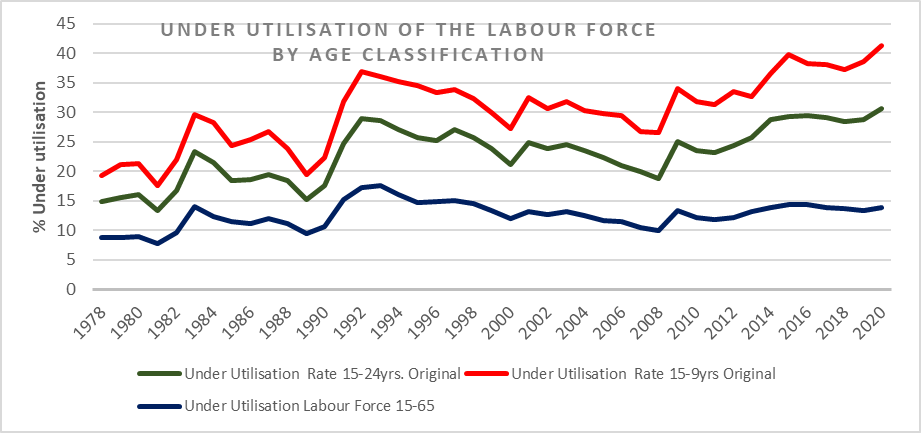
- 2020 data to Feb
- Blue Curve: labour force underutilisation rate 15-65 years
- Green Curve: underutilisation rate 15-24 years
- Red Curve: underutilisation curve labour force 15-19 years
Following rejection of the economics of J.M. Keynes in 1971 following collapse of the Bretton Woods fixed exchange rate system, Australia moved first to monetarism; and then global monetarism. As Australian major political parties committed to globalised internationally competitive industry policies, the highly protected post World War II economy was dismantled. Consequently, post War full employment defined by the Vernon Committee as a range between 1% -1.5% unemployment was replaced with the monetarist natural rate of unemployment ranging between 4.5% and 5.5% unemployment. Under employment, though, has never been publicly recognised in contemporary economic debate. This discussion recognises both unemployment and underemployment in its official composite form: underutilisation rate.
Underutilisation rates in Chart 1 illustrates serious inefficient use of the Australian labour force. The addition of a further 5%-10% unemployment will generate a magnitude of economic dislocation not witnessed since the Great Depression. Whilst economic recovery strategies are available, they lie beyond economic philosophies which assume full employment output and competitive markets as their analytical starting point. As classical, neoclassical; and, monetarists schools of economics, are all based upon such unrealistic assumptions, it is naive to expect global monetarism to rebuild Covid-19 discretionary economic contraction.
Australian political debate must now select a different economic philosophy to structurally reform a free market internationally integrated industrial base post Covid -19. The political reality is starting to emerge amongst major political parties, free market commentators, and academic economists. Currently, Government is uttering slogans about reclaiming “national sovereignty” and “economic sovereignty” whilst Labor is talking about a model drawn from post 1945 War reconstruction. Meanwhile, free trading globalist academics are grudgingly accepting some form of narrow re-industrialisation through selected high tech medical and pharmaceutical industries. The recovery debate then becomes a political decision which must wrestle with the question of which economic philosophy can effectively restructure entrenched free market globalisation. That restructure must rebuild manufacturing and import replacement sectors to broaden and deepen the depleted industrial base.
Chart 1 illustrates the magnitude of the problem confronting the political class. If 5%–10% additional unemployment is added to the labour force underutilisation rate, Australia like America, is looking down the barrel of depression levels of labour force dislocation. The failure of post Bretton Woods move to free market economics is now on display
3. The Structural Problem
Chart 2.
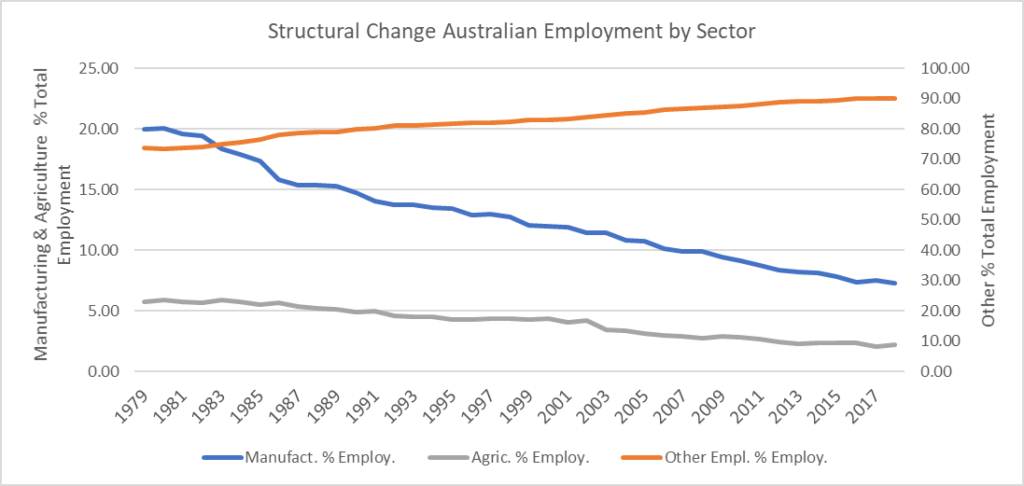
- Blue curve; % manufacturing employment
- Grey curve; % agriculture % employment
- Orange Curve; % other employment
Chart 2 demonstrates empirically through changing sectoral employment structural remodelling of the underlying industrial base of the economy post 1983. Empirical analysis shows manufacturing declined from 20% of the labour force in 1981 to 7.3% in 2018. Agricultural employment declined over the same period from around 6% to 2.2%. The services sector though expanded rapidly from 73% of the labour force to 90% in 2018. The policy difficulty is that some service industries such as tourism are characterised by part time low paid employment.
Changes to the industrial base must indirectly impact upon economic growth. Whilst the contribution to economic growth from manufacturing and agriculture is calculated on a value-added output basis, service industries contribution is calculated by wage or income increments. Herein lies a dilemma for central bank inflation targeting. The key policy target in the services sector, wage growth, becomes compromised with respect to growth.
Moreover, monetary policy strategy pursuing the natural rate of unemployment appears to have been achieved at the expense of Australia’s young workers. If the expected minimum 5% increase in unemployment occurs equally across all age groups, overall labour force underutilisation rises from approximately 14% to 19%. For the 15 to 24 year age group, the underutilisation rate increases from 31% to 36% whilst the 15-19 year age group, the rate rises from 41% to 46%. Whilst underutilised labour is not recognised in the natural rate of unemployment, these levels of underutilised labour seriously erode Australia’s social fabric.
Underutilisation of the labour force is demonstrable proof of an inefficient use of the nation’s labour force and directly challenges the wisdom of pursuing production efficiency to achieve international competitiveness. Claims that post 1983 structural reforms have delivered an efficient internationally competitive economy look very shallow when underutilisation of a nations labour force is recognised as eroding the social fabric. The question therefore becomes one of selecting an economic philosophy which will deliver an appropriate policy direction capable of rebuilding an industrial base delivering full employment, an equitable distribution of income, and rising living standards.
4. Policy Direction: Income Distribution
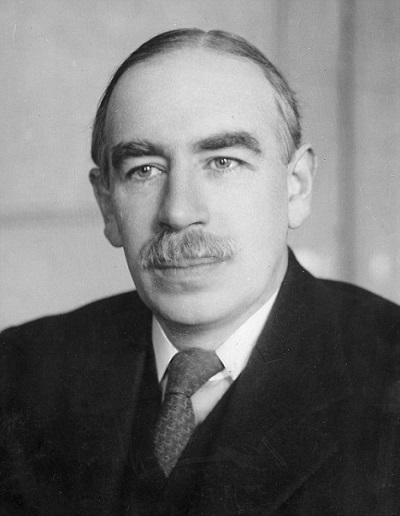
“The outstanding faults of the economic society in which we live are its failure to provide for full employment and its arbitrary and inequitable distribution of wealth and incomes”
J.M.Keynes:
The General Theory of Employment, Interest and Money
Keynes went on to say that
“measures for the redistribution of incomes in a way likely to raise the propensity to consume may prove positively favourable to the growth of capital”
To support international competitiveness, wage determination was moved from historic arbitration to collective bargaining post 1983 election of Labor. Whilst the Hawke era moved away from State and Commonwealth arbitration systems to favour collective bargaining, the Keating Administration’s 1993 Working Australia White circumvented the Constitutional Arbitration Power {Section 51 (xxxv)} with the Corporations Power {Section 51 (xx)} to form a national industrial system.
Australia’s historic arbitration system was originally based upon the Harvester Judgement of 1907 which required an adequate level of income necessary for an employee to be fed, clothed and housed with some meagre level of comfort This changed over time; but, the principle of an adequate basic income remained constant. Post 1993, a minimum wage replaced the historic basic income concept. The minimum wage is little more than a subsistence income for lower skilled workers.
By ignoring underemployment, the natural rate of unemployment cannot help but preside over an inequitable distribution of income. Consequently, the propensity to consume is constrained and investment expenditure curtailed. Unlike Keynesian counter cyclical fiscal stimulus, monetarism is restricted to monetary policy instruments. For effective policy. monetarism depends upon the income velocity of money being greater than unity. Chart 3 shows that this is not the case. Consequently, RBA monetary policy is reduced to ineffective “jawboning”. More importantly, effective income distribution lies beyond monetary policy.
Chart 3.
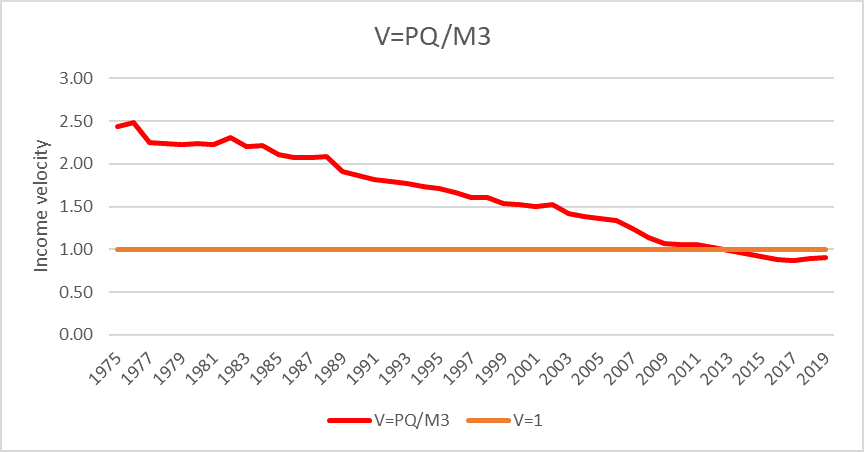
- Red Curve; Income velocity = Price*Quantity/ M3
- Orange curve= [1= { V=PQ/M3} ]
The importance of an equitable distribution of income in economic policy can be found in economic literature in early nineteenth century writings of Lord Lauderdale (Hanson; Business Cycle Theory, p. 229). Despite this historic concern with the importance of income distribution, “modern” economic thought has discarded income distribution policies in favour of another group of late seventeenth and early eighteenth century competitive market theorists i.e. David Hume, Adam Smith, David Ricardo, and J.B. Say. Meanwhile, modern competitive market proponents reliant upon levels of unemployment and under employment sufficient to maintain wage discipline directly contribute to an inequitable distribution of income.
5. Policy Direction Import Replacement

“ spending on imports ‘leaks’ out of the Australian spending -production- circuit into circuits of the countries selling to us”
Economics.
Samuelson Hancock Wallace, p.268

“ For the neo-classicals a belief in Free Trade became the very hallmark of an economist; protectionists belonged to the lesser breeds without the law”
Joan Robinson
Economic Philosophy, p.61
The quotation from Joan Robinson explains post 1983 political enthrallment with global monetarism and internationally competitive industries. Major Australian political parties regressed to late nineteenth century and early twentieth century economic theory that failed miserably in the Great depression. That had to be a political decision of the prevailing political class besotted with academic theory unquestioned by practical commentators across the media, business , trade unions; and, socio economic groups

“the bulk of economics as a discipline is carried out within universities around the world, with———–small groups of the initiated musing to each other———-despite overwhelming empirical evidence against the validity of its theories”
Paul Omerod
Death of Economics p. 67
To rebuild an industrial base adequate to provide full employment, reasonable incomes, and rising living standards will require an import replacement strategy to rebuild a manufacturing sector. Australian ownership must be paramount to prevent negative net income flow generating external imbalance. Covid-19 policy dislocation has identified the necessity of this policy direction.
5. Conclusions
Post 1983 structural reform has been identified as a political decision to pursue efficiency in production. That decision has been at the expense of an efficient use of this nations labour force and income distribution. Consequently, Australia’s social fabric has been seriously eroded. To restore full employment, an equitable income distribution, and rising living standards, post Covid 19 reform must embrace:
- Import replacement industries
- Rebuild manufacturing
- Address foreign ownership impact upon external balance
- Equitable redistribution of income
- Collective bargaining and subsistence minimum income reviewed
- Progressiveness of the taxation system reviewed
END

About Ben Rees B. Econ.; M. Litt. (econ.)
Economist, Farmer, Researcher, public speaker.
Import Replacement. An Option For Economic Recovery
The proposition that “the time for new ideas has arrived“, is highlighted by the Federal Coalition Government, now advocating deficit spending to achieve higher economic activity and ultimately employment. They are even asserting higher employment is required to lift wages, yet they have been through time, perhaps the most vociferous advocates of austerity and wage
Read more
The Making of History
I am a recent user of Twitter, and I have enjoyed the discourse therein, I noted the ABC radio announcer Steve Austin had made a comment about an article; it was rather strong for Steve I thought. That article written by Rutger Bregman; https://thecorrespondent.com/466/the-neoliberal-era-is-ending-what-comes-next/61655148676-a00ee89a carefully articulates the back-story of government changed, and we saw the
Read more
Toward a Stable Farm Sector – Multi Peril Insurance
Farmers First began life with the intention of facilitating the delivery of a Multi Peril Insurance product for the cropping sector around Australia, and once bedded down, rolling it out to other cropping and then livestock industries. Most of the rest of the developed and even developing world has this insurance cover, and in many
Read more